
Top LMS Solutions for Designing Learning Content
How No-Code LMS Authoring Tools Transform Training into a Scalable Learning Engine
In 2026, simply having a learning management system is not enough. The real advantage comes from whether your teams can create, update, localize, and publish engaging learning content quickly without relying on long production cycles or technical specialists.
Modern learning and development teams need to approach training like a product release. Frequent updates, measurable impact, and consistent learner engagement are key to success.
Learning Lab LMS provides an all-in-one environment for training management. The platform includes content creation tools, structured learning paths, live events and scheduling, document libraries, and social learning features such as forums, chat, gamification, and learner challenges.
Equally important is the data and analytics framework. A good LMS allows teams to track learner progress, generate detailed reports, filter data, and customize dashboards to focus on the most meaningful insights.
The game-changer is the no-code authoring tool built into modern LMS platforms. With interactive templates, animations, mobile previews, and widgets such as flash cards, drag-and-drop exercises, hot spots, and interactive videos, teams can develop branded, mobile-friendly learning experiences quickly and efficiently.
By empowering trainers to become creators, content creation speed improves, ensuring that training stays relevant in fast-paced industries. A no-code LMS authoring tool makes it possible to deliver high-quality, engaging training at scale, without technical bottlenecks.
Content Creation as a System, Not Just Files
From PowerPoints and PDFs to Reusable Learning Blocks
Many organizations still think of content creation as building PowerPoints, exporting PDFs, and sharing links. The issue is not the effort—it’s that files do not function like modern learning. They are difficult to measure, hard to update, and easy for learners to overlook.
Learning Lab LMS changes this by providing a branded, interactive learning environment. The platform includes assessments, social learning via chat and forums, gamification, mobile access, and reporting and analytics to track learner progress and engagement.
A blended learning approach allows organizations to:
Move beyond one-off courses and deliver reusable learning modules.
Update content by swapping modules instead of rebuilding entire courses.
Align content releases with seasonal campaigns, promotions, and operational priorities.
Maintain brand consistency through templates and governance, ensuring every module reflects the company’s identity.
When content creation becomes a system, teams can produce training faster, maintain higher quality standards, and sustain a learning culture over time instead of releasing content that quickly loses relevance.
The Orchestra Model: Four Levels of Content Creation
From Learning Journeys to Engaged Learners
Learning Lab LMS features a powerful no-code authoring tool designed to make content creation for LMS both fast and engaging. With branded templates, animations, one-click translation, and interactive experiences like drag-and-drop exercises, flash cards, interactive videos, and hotspots, it empowers teams to build high-quality, mobile-friendly learning content.
Think of content creation in Learning Lab LMS like an orchestra:
The Pieces – Learning Journeys: These are the core topics or training programs, representing the main objectives of your learning initiatives.
The Sections – Content Formats: This includes structured learning paths and individual modules that make up the full experience.
The Instruments – Interactive Widgets: Tools like quizzes, drag-and-drop exercises, and interactive videos bring interactivity and engagement to each module.
The Musicians – Trainers and Learners: Retail trainers, L&D teams, regional managers, and store staff bring the content to life, ensuring the learning experience is applied in real-world scenarios.
Level 1: The Musical Pieces – Learning Paths
At the top of the content creation orchestra, the “musical pieces” represent your Learning Paths—complete learning experiences, not individual courses or a random list of modules. Learning Paths are structured journeys designed to guide learners from initial exposure to full capability on the job.
A Learning Path in Learning Lab LMS is made up of:
Classes: Landing pages that introduce the main topic or objective.
Courses: Containers for a specific topic, skill, or capability.
Modules: Chapters that structure learning progression.
Lessons: Micro-units that teach one skill or concept at a time.
Quizzes and Assessments: Practice and evaluation moments that confirm understanding and readiness.
Learning Paths are commonly used for:
Onboarding: Step-by-step guidance for new hires, avoiding overwhelm from large content libraries.
Seasonal campaigns and product collections: Training sequences that mirror real-world store operations and sales priorities.
Selling ceremonies, clienteling routines, and after-sales behaviors: Skills are learned, practiced, and reinforced over time.
Designing learning with Learning Paths shifts focus from “content uploads” to measurable learning outcomes. A well-built path transforms an LMS from a platform that is occasionally visited into a system that produces confident, job-ready performance.
Level 2: The Orchestra Sections – Core Content Formats
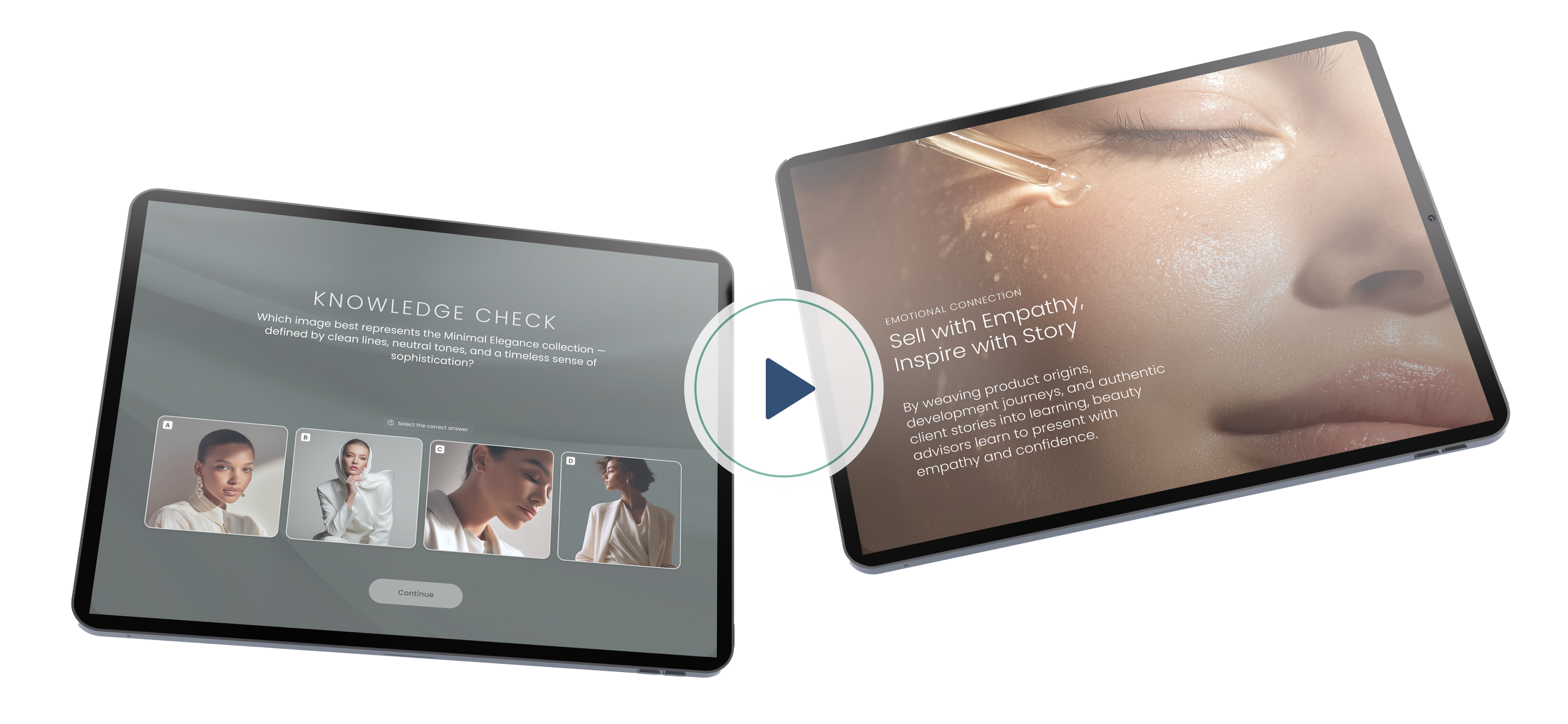
The orchestra sections represent the core content formats that make learning journeys varied, engaging, and mobile-friendly. These formats ensure that learners remain engaged, while supporting different skills and learning preferences.
Learning Lab LMS supports a wide range of modern learning formats, including:
Audio and video content: Short videos, tutorials, and presentations to explain concepts visually.
Documents, images, and library assets: Reference materials that reinforce learning.
Interactive assessments and quizzes: Flash cards, hotspots, video-based tests, live exams, and interactive exercises.
Community touchpoints: Chat, forums, and social learning for peer interaction and collaboration.
Gamification, achievements, and challenges: Incentives that increase engagement and reinforce skills.
These sections create rhythm within Learning Paths. They prevent learning from feeling repetitive and allow you to match content formats to the skills being taught, ensuring that employees gain practical, job-ready knowledge.
Level 3: The Instruments – Interactive Widgets That Drive Engagement
The instruments in your learning orchestra are the interactive widgets that transform passive content into engaging, hands-on experiences. This is where Learning Lab LMS goes beyond a traditional LMS to become a creative learning studio.
With Learning Lab’s no-code authoring tool, teams can use interactive features such as:
Drag-and-drop exercises for practical skill application
Flash cards for knowledge reinforcement
Interactive videos that combine instruction with real-time engagement
Hotspots to explore content visually and actively
What these instruments achieve:
Turn static information into active practice, boosting knowledge retention.
Make learning feel like a mobile app experience, rather than a passive slide deck.
Validate learner understanding through interaction, not just content delivery.
Most organizations don’t struggle with content—they struggle with learner engagement. The right interactive widgets in Learning Lab LMS ensure that learning is practical, measurable, and performance-focused, turning information into real-world capability.

Level 4: The Musicians – The Teams That Bring Learning to Life
Even the most advanced LMS authoring tool cannot create impact alone. In Learning Lab LMS, the musicians are the people who conduct, coach, and keep learning alive. They are the teams that drive adoption, engagement, and measurable performance in real-world environments.
Who the musicians are and what they do:
Trainers and L&D teams: Design learning journeys, create modules, maintain quality standards, and deploy seasonal updates.
Retail excellence and performance teams: Define processes, align training with key performance indicators, and connect learning to real behaviors.
Store operations teams: Translate guidelines into practical micro-content and ensure consistent execution across locations.
Store managers: Activate learning daily, run briefings, coach on the floor, and reinforce participation with recognition and incentives.
While platforms like Learning Lab LMS scale content delivery, it’s people who scale learning culture. When all the musicians are aligned, the learning orchestra performs consistently, ensuring employees are confident, skilled, and ready to deliver results.
The Basics That Create Clarity – Trusted Text, Documents, Images, and Video
The basic widgets in an LMS are anything but basic. They form the foundation for fast content production and global scalability, especially when paired with branded templates and governance. Learning Lab LMS emphasizes creating branded, visually engaging, and interactive courses through its creative authoring tool, making even simple content impactful.
Where the basics shine in retail training:
Text blocks: Clear guidance for what to say and what not to say on the sales floor.
Document viewer and library: Operational standards, guides, and reference materials.
Image blocks: Visual merchandising, product details, and material recognition.
Video blocks: Selling ceremonies, product handling, and storytelling for brand or craft.
Best practices to make basics effective:
Use store-level language rather than corporate jargon.
Focus each screen on one clear message.
Leverage short videos and captions for mobile-first consumption.
Always include a next action, such as a quiz, scenario, or checklist.
When the basics are clean, fast, and brand-consistent, learners trust the platform. Learning Lab LMS ensures these foundational elements are easy to create, update, and maintain, encouraging repeated engagement and building a culture of continuous learning.
Experience Widgets That Make Learning Feel Premium
Buckets, Accordions, Flashcards, Hotspots, and Carousels
This is where training content stops feeling like a static slideshow and starts feeling like a modern, interactive app. Learning Lab LMS offers a suite of experience widgets—including flashcards, hotspots, accordions, buckets, and carousels—that make learning engaging, dynamic, and mobile-friendly.
How to use experience widgets in retail training:
Accordions for product storytelling: Organize content by inspiration, craftsmanship, materials, care instructions, or cross-sell guidance.
Buckets for collections: Group products by family, material, or usage occasion for easy navigation.
Flashcards for rapid recall: Reinforce key terms, care rules, or material differences.
Carousels for visual comparison: Highlight visual merchandising changes, seasonal product updates, or icon evolutions.
Hotspots for product anatomy: Allow learners to tap on details to reveal product benefits and client-facing value.
Why experience widgets matter:
Improved learning flow on mobile with clean, easy-to-navigate screens.
Higher completion rates because content feels interactive and visual.
Faster updates as modular blocks can be swapped or refreshed without rebuilding entire courses.
For retail, especially in luxury or premium brands, learning must feel as thoughtful as the in-store experience. Experience widgets in Learning Lab LMS deliver that same level of care and engagement in digital training.

Assessment and Practice Widgets – Reinforcing Learning Through Interaction
True/False, Multiple Choice, Visual Matching, Ordering, Fill-in-the-Blanks, Slider, and Scale
Quizzes and interactive assessments are not just for evaluation—they are powerful tools for reinforcement and skill practice. Variety matters because different skills require different types of exercises, and retail teams need practice that mirrors real-world situations.
Learning Lab LMS provides a range of interactive assessment widgets and learning activities, including quizzes, video tests, live exams, and webinars, making engagement measurable and meaningful.
How to match assessment types to retail skills:
True/False: Quick myth-busting for care rules, compliance, or product facts.
Multiple Choice: Reinforce product pillars and feature-to-benefit translations.
Visual Matching: Teach material recognition, icon families, or packaging standards.
Ordering: Practice selling ceremony sequences or after-sales workflow steps.
Fill-in-the-Blanks: Reinforce brand language, key phrasing, and mandatory vocabulary.
Slider and Scale: Confidence checks, service self-assessments, and manager coaching prompts.
Best practices for luxury-friendly assessments:
Use scenario-based questions, not academic exercises.
Incorporate visuals and product context for authenticity.
Provide immediate feedback in the brand’s tone of voice.
Practice bridges the gap between content and performance. When assessments simulate real store situations, they do more than test knowledge—they improve readiness, confidence, and on-the-job performance.
What Makes Learning Lab LMS Different for Content Creators
A Platform Built for Branded Learning, Speed, and Continuous Updates
Many learning platforms can host content, but few enable teams to create, update, and scale branded learning quickly. Learning Lab LMS is designed with content creators in mind, offering a fully customizable, no-code, white-label solution that combines creative authoring tools, SCORM compliance, automatic translation, mobile apps, social learning, and robust reporting and analytics.
The platform’s authoring tool includes branded templates, animations, mobile preview, duplication tools, and integrated project management, streamlining collaboration and publishing workflows for faster, higher-quality content production.
This approach matters because in retail and luxury brands, content production is continuous, not a one-time project. Training must keep pace with seasonal drops, campaigns, visual merchandising updates, service rituals, and clienteling practices.
What this enables in practice:
Faster content updates: Refresh seasonal or campaign materials without rebuilding entire courses.
Brand consistency: Maintain high-quality, on-brand content through templates and style control.
Engagement loops: Use interactive learning, gamification, and social features to boost participation.
Measurable progress: Track learner outcomes through detailed reporting and analytics.
Smoother collaboration: Integrated project management and feedback flows streamline teamwork.
The right LMS is not just a place where learning lives—it’s where learning is created, improved, and delivered continuously. Learning Lab LMS empowers content creators to produce high-quality, branded, and mobile-friendly learning at scale.

The 2026 Content Creation Advantage
In 2026, retail learning teams are expected to deliver faster updates, stronger engagement, and measurable performance outcomes, all while acknowledging that store teams have limited time and high expectations.
The most effective LMS solutions for content creation are not the ones with the longest feature lists; they are the platforms that turn training development into a repeatable, scalable system.
The strongest systems function like an orchestra.
First, the musical pieces are defined through structured Learning Paths that guide learners from onboarding to seasonal readiness, icon mastery, selling ceremonies, store operations, clienteling, and after-sales routines. These paths create clear direction and prevent learners from feeling overwhelmed by scattered content.
Next, the orchestra sections are built through a variety of core content formats that make learning engaging and modern. Audio and video lessons, documents and library assets, interactive assessments, community touchpoints, and gamification rituals keep training alive and measurable. Learning Lab LMS positions these elements as key engagement drivers for retail teams, while mobile access and robust analytics ensure adoption and progress can be tracked effectively.
The instruments in this orchestra are the interactive widgets that transform static information into dynamic learning experiences. Learning Lab’s authoring tool allows teams to create drag-and-drop exercises, flashcards, interactive videos, hotspots, and fully branded templates with animations and mobile previews. Training becomes modular and reusable, allowing single elements to be updated without rebuilding entire courses, which keeps learning relevant month after month.
Finally, the musicians are the people who bring the content to life. Trainers, retail excellence leaders, performance teams, store operations staff, and store managers maintain the cadence of learning, translating standards into daily rituals, coaching in real moments, and turning content into habitual behaviors. While the LMS distributes training globally, it is the people on the ground who create the energy that makes learning stick and drives real performance.
When training is crafted with the same attention given to the client experience, it feels premium and intentional. Learning Lab LMS puts that craft into the hands of retail excellence teams, enabling continuous, branded, and scalable learning that drives measurable results across every store location.